
Ammonia Charge Calculation Methods: Component-Level Methodology Explained
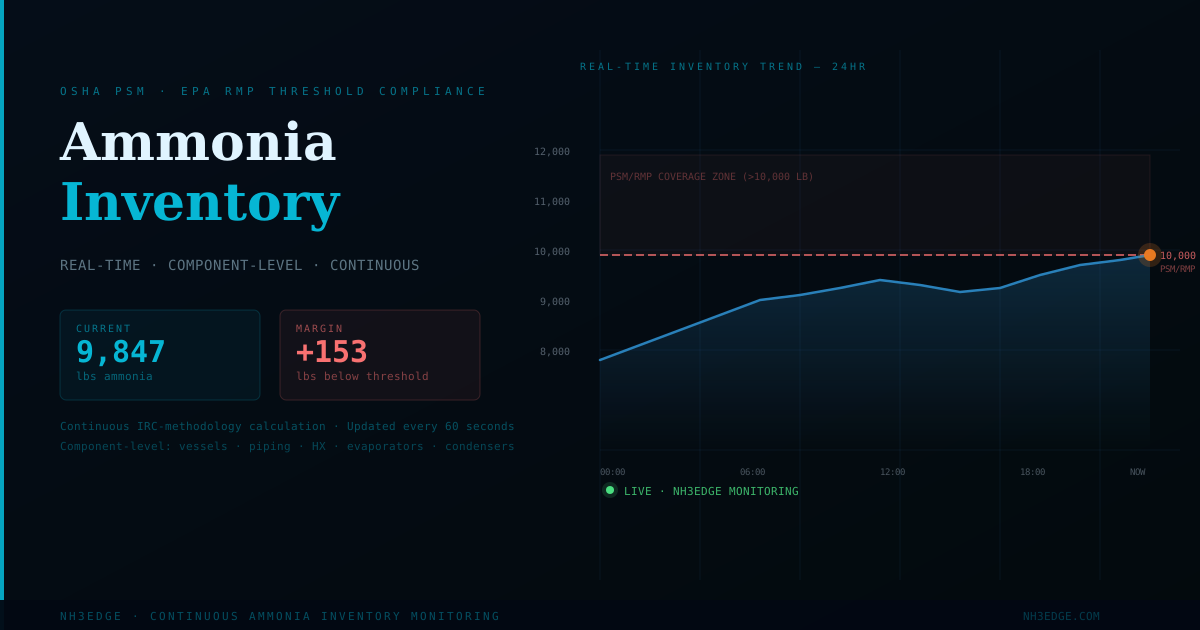
Every ammonia refrigeration facility needs to know how much ammonia is in its system. That number drives regulatory thresholds (both the PSM 10,000-pound trigger and the RMP Program level determination), informs emergency response planning, and serves as a fundamental process safety data point. Yet at most facilities, the "ammonia inventory" figure is a number someone estimated during system commissioning and hasn't been seriously revisited since.
Industry charge management guidance, including IIAR's published guidelines, points to the same answer: a rigorous, component-level framework for calculating system charge from actual operating conditions. Understanding how that calculation works, and how continuous monitoring can automate it, is the focus of this post.
Why Point-in-Time Estimates Fall Short
The traditional approach to ammonia inventory at most facilities is a single number on a compliance document — often derived from the system contractor's commissioning records or a rough calculation from vessel nameplate data. This approach has several problems:
- It's static. Ammonia distribution within a system changes continuously with operating conditions. The amount of liquid in a high-pressure receiver at full load is different from the amount at light load; the charge in an evaporator during defrost is different from the charge during refrigerating mode.
- It doesn't account for additions and losses. Systems gain ammonia through maintenance-related additions and lose ammonia through leaks and venting. Without systematic tracking, the stated inventory diverges from reality over time.
- It can't identify redistribution. An overfilled vessel is a safety hazard — particularly on the low side where overfilling can result in liquid carryover to a compressor. A static charge estimate provides no visibility into per-vessel distribution.
The Foundation: Thermodynamic Properties of Ammonia
The calculation is built on the thermodynamic properties of ammonia — specifically the relationship between temperature, pressure, and the physical state (liquid, vapor, or two-phase mixture) of the refrigerant at each point in the system.
The key property tables used are:
- Saturated ammonia properties: At any saturation pressure, the specific volume of saturated liquid (v_f, ft³/lb) and saturated vapor (v_g, ft³/lb) are fixed. These values are tabulated in ASHRAE Fundamentals and NIST Refrigerant Properties databases and are the foundation of all charge calculations.
- Superheated vapor properties: For vapor-phase regions (compressor suction lines, discharge lines at high temperature), the specific volume depends on both temperature and pressure.
- Subcooled liquid properties: For liquid below its bubble point at a given pressure, a small correction to the saturated liquid specific volume applies, though for most practical calculations this correction is minor.
m = V / v
Where:
- m = mass of ammonia in the component (lb)
- V = volume of ammonia in the component (ft³)
- v = specific volume of ammonia at the component's conditions (ft³/lb)
Component-Level Calculation Methodology
The component-level approach calculates charge separately for each significant component in the system and sums to a total. Here's how the calculation applies to the major component types:
High-Pressure Receivers and Intercoolers
High-pressure receivers operate in a two-phase condition: some liquid at the bottom, saturated vapor in the headspace above. The charge in a receiver is:
m_receiver = (V_liquid × ρ_liquid) + (V_vapor × ρ_vapor)
Where:
- V_liquid = liquid volume, calculated from vessel geometry and level measurement (ft³)
- V_vapor = vapor volume = total vessel volume − V_liquid (ft³)
- ρ_liquid = density of saturated liquid at receiver conditions = 1/v_f (lb/ft³)
- ρ_vapor = density of saturated vapor at receiver conditions = 1/v_g (lb/ft³)
This calculation requires knowing the vessel geometry precisely — total internal volume, and the relationship between level reading and liquid volume (which varies by vessel orientation and head geometry).
Shell-and-Tube Evaporators and Condensers
Flooded shell-and-tube evaporators — common in industrial ammonia systems for process cooling — typically contain a liquid pool on the shell side with vapor space above. The calculation follows the same two-phase approach as receivers, using shell-side pressure and level.
Air-cooled evaporators and direct-expansion coils present a more complex picture because the refrigerant phase distribution varies along the circuit length and changes significantly with load. For these components, the methodology typically uses a circuit-by-circuit analysis based on inlet conditions, outlet conditions, and a model of the phase distribution along the coil length. In practice, for continuous monitoring applications, these components are often addressed with a conservative liquid-filled assumption or a simplified model.
Low-Pressure Receivers (Accumulators)
Low-pressure receivers in recirculation systems are two-phase vessels operating at suction pressure. The calculation is identical in form to high-pressure receivers but uses the lower-pressure saturation properties — which means lower liquid density and higher vapor density. At typical suction pressures (-20°F to +20°F saturation temperature), the density of saturated liquid ammonia ranges from approximately 40 lb/ft³ to 42 lb/ft³.
Overfilling a low-pressure receiver is one of the most dangerous conditions in an ammonia recirculation system. Component-level calculation, applied with continuous level monitoring, provides real-time visibility into receiver liquid level — an early warning capability that a static inventory estimate cannot provide.
Liquid Ammonia Piping
Liquid-filled piping sections contain ammonia at approximately the density of saturated liquid at the prevailing pressure. For subcooled liquid lines (high-pressure liquid from the receiver to the expansion device), the charge calculation uses the saturated liquid specific volume at the condensing pressure.
Piping charge is calculated from the internal volume of each pipe segment (from pipe size and length data) multiplied by the liquid ammonia density. While individual pipe segments may contain small masses, large systems with extensive liquid distribution piping can have significant charge tied up in piping — a component that static estimates frequently undercount.
For suction lines and hot gas lines, which carry vapor or two-phase mixtures, the specific volume of the vapor phase is much larger (lower density), so the charge per unit volume is substantially lower than for liquid lines.
Oil Separators and Oil Pots
Screw compressor systems contain significant oil inventory in separators, and some oil always contains dissolved ammonia. The methodology includes an accounting for ammonia dissolved in oil, using published solubility data for ammonia in refrigeration oil at the operating temperature and pressure of the separator.
Calculating Total System Charge
The total system charge is the sum of component charges:
m_total = Σ m_component
For a large ammonia refrigeration system with multiple vessels, heat exchangers, and extensive piping, this sum may include 20 to 50 individual component calculations. The complexity is manageable with software tools but is prohibitively labor-intensive as a manual calculation — particularly at the frequency needed for meaningful monitoring.
How NH3Edge Automates the Calculation
NH3Edge implements this component-level methodology as a continuous, automated calculation rather than a periodic manual exercise. The platform integrates with the facility's sensors — pressure transmitters, level transmitters, and temperature sensors throughout the system — and executes the component-level calculation in real time, typically updating every few seconds.
The result is a live ammonia inventory dashboard that shows:
- Total system charge at the current moment, calculated from actual process conditions
- Per-vessel inventory, allowing operators to see how charge is distributed across the system
- Trend data, showing how inventory has changed over time — revealing gradual losses that indicate system leakage
- Alerts when total inventory falls below or rises above defined thresholds
The underlying thermodynamic property calculations use NIST Reference Fluid Thermodynamic and Transport Properties Database (REFPROP) data for ammonia, ensuring accuracy across the full range of operating conditions encountered in industrial refrigeration systems.
Practical Benefits Beyond Compliance
Component-level calculation, continuously applied, delivers operational benefits that go beyond regulatory compliance:
- Early leak detection: A gradual downward trend in calculated total inventory — even before any detector activates — signals refrigerant loss and allows maintenance to be dispatched before a significant release occurs.
- Overfill prevention: Real-time per-vessel charge data provides operators with immediate feedback during refrigerant transfer and charging operations.
- Maintenance planning: Accurate per-vessel inventory is essential for planning maintenance on individual system sections — knowing exactly how much ammonia must be transferred before a vessel can be isolated for service.
- Regulatory reporting: When the EPA RMP or OSHA PSM documentation calls for current ammonia inventory, a continuous component-level calculation provides a defensible, documented answer rather than an aging estimate.
Questions about continuous ammonia inventory monitoring or component-level charge calculation? Contact NH3Edge for a consultation.
Understanding the 10,000-Pound Threshold: When PSM and RMP Apply to Your Ammonia System
The 10,000-pound ammonia threshold triggers two of the most consequential regulatory programs in industrial safety. Here's what it means, how it's determined, and why so many facilities don't know where they actually stand.
Monitoring TechnologyStatic vs. Dynamic Ammonia Inventory: Why Your Paper Number Might Be Wrong
Most facilities calculate their ammonia inventory once and file the number. But refrigerant charge is not static — it migrates continuously between vessels as operating conditions change. Here's what that means for your compliance position.
Artificial IntelligenceAI in the Ammonia Refrigeration Control System: Four Places It Earns Its Keep
AI in an ammonia machinery room is not about letting software run the plant. It's about finally being able to ask the historian a question in plain English, ask the PLC program what an interlock actually does, understand how the system behaves as a whole, and pull compliance evidence from the data that was already there. Here's where it delivers, and where the guardrails have to be.
Operating an ammonia refrigeration facility?
NH3Edge provides OSHA PSM and EPA RMP compliance consulting for ammonia refrigeration facilities — third-party compliance audits, ammonia inventory determination, and continuous real-time inventory monitoring. Based in Salt Lake City, serving facilities nationwide.