
EPA RMP Amendments: What Ammonia Facilities Need to Know
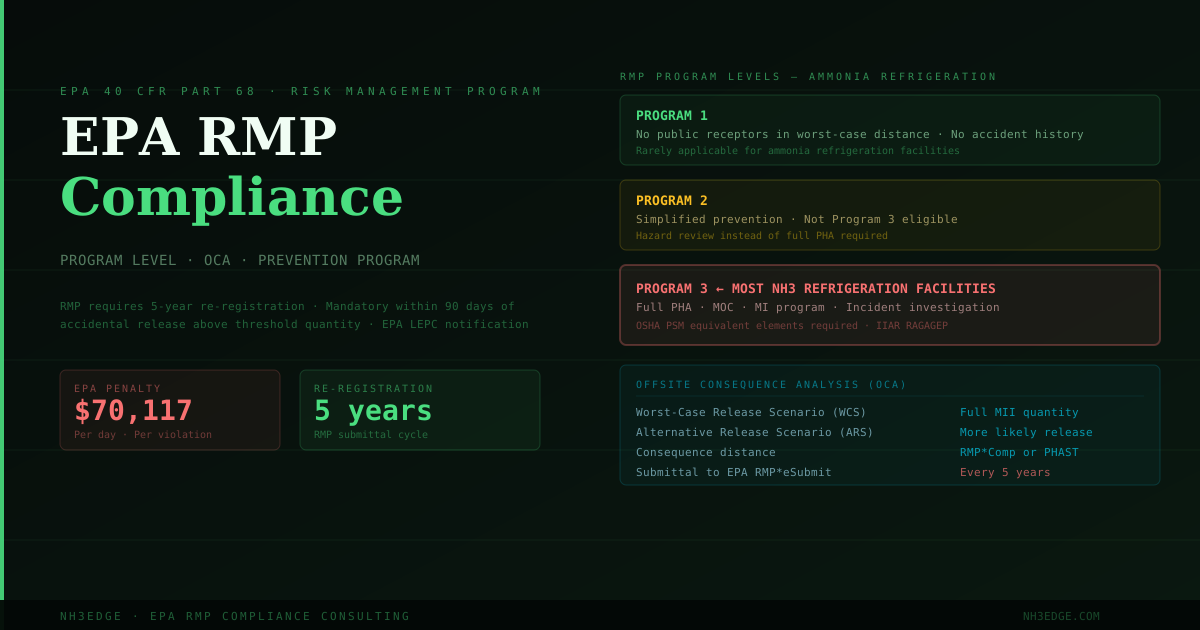
The EPA's Safer Communities by Chemical Accident Prevention (CCCAP) rule, published in the Federal Register on March 11, 2024, represents the most significant revision to the Risk Management Program regulations at 40 CFR Part 68 since the original rule was promulgated in 1996. For ammonia refrigeration facilities that hold Program 3 status — those with processes above the 10,000-pound threshold subject to OSHA PSM — the amendments introduce substantive new requirements in six major areas, with implementation deadlines that have already begun.
Understanding what changed, what it means specifically for ammonia refrigeration operations, and how to assess your facility's compliance posture against the new requirements is the focus of this post.
Background: Why the Amendments Were Issued
The CCCAP rulemaking was driven by two factors: the findings of a 2016 Obama-era RMP amendment that was subsequently rescinded in 2019 under the Trump administration, and a sustained pattern of significant chemical accidents — including several high-profile ammonia releases — that highlighted gaps in the existing RMP framework.
EPA's analysis of the accident record identified consistent themes: facilities that lacked robust third-party verification of their safety programs, emergency response plans that weren't coordinated with local responders, and accident investigations that identified contributing causes without addressing root causes. The CCCAP amendments target each of these gaps directly.
The rule's compliance dates are staggered, with some requirements effective immediately upon publication in March 2024 and others with 18-month or 3-year implementation windows. Facilities that are still assessing whether they need to act should recognize that for Program 3 facilities, significant new obligations are already in effect.
New Requirement 1: Third-Party Compliance Audits
The most operationally significant change for most Program 3 ammonia facilities is the new third-party compliance audit requirement. Under the amended 40 CFR Part 68.58, Program 3 facilities must now ensure that compliance audits are conducted by a third party — or a team that includes a third-party auditor.
What This Replaces
Previously, the RMP regulations at 40 CFR Part 68.58 required compliance audits at least every three years but placed no restriction on who conducted them. Many facilities used internal personnel — HSE managers, process engineers, or compliance staff — to conduct these audits. The amended rule eliminates this option for Program 3 facilities by requiring that the auditor (or at least one member of the audit team) meet criteria for independence and competency:
- Independence: The auditor must not be an employee of the facility being audited. Related-party auditors (e.g., corporate HSE staff from the same organization) are prohibited for Program 3 facilities.
- Competency: The third-party auditor must have demonstrated knowledge and experience in applicable industry standards, process safety, and relevant regulations.
Practical Implications for Ammonia Facilities
For ammonia refrigeration facilities, this means the next compliance audit — due within three years of the last audit, on the existing schedule — must involve a qualified external auditor. The auditor should demonstrate familiarity with:
- OSHA 29 CFR 1910.119 (PSM) and its application to ammonia systems
- IIAR standards (IIAR 2, IIAR 9, Bulletin 110) as the applicable RAGAGEP
- EPA 40 CFR Part 68 and the specific Program 3 requirements
- Ammonia refrigeration system design and operation
New Requirement 2: Root Cause Analysis for Accidents and Near-Misses
The amended 40 CFR Part 68.60 expands the accident investigation requirements to mandate root cause analysis (RCA) for any accidental release that met the reporting threshold (a release that caused deaths, injuries, or significant property damage) and for near-miss events that had potential for such consequences.
The Difference Between Causal Analysis and Root Cause Analysis
Under the prior rule, incident investigations were required to identify the causes of accidents. In practice, many investigations identified proximate causes — "the valve was left open," "the level transmitter failed" — without pursuing the systemic factors that allowed those proximate causes to result in an incident. Root cause analysis, by contrast, requires methodically tracing causal chains back to the organizational or systemic conditions that were necessary contributors.
EPA's regulatory preamble specifically references methods like the Fishbone (Ishikawa) diagram, Fault Tree Analysis, and 5-Why analysis as approaches consistent with the root cause analysis requirement. The point is not to mandate a specific method but to require that investigations go beyond the immediate physical cause to identify contributing organizational, procedural, and design factors.
Why This Matters for Ammonia Facilities
For ammonia refrigeration operations, the most common near-miss events — inadvertent releases during maintenance, PRV activations, ammonia detector alarms — often have root causes in procedural deficiencies, inadequate training, unclear valve labeling, or failed MOC processes. An RCA-compliant investigation of these events would surface those systemic issues and connect them to corrective actions that actually prevent recurrence.
Under the amended rule, root cause analysis reports must be retained for five years and made available to employees and their representatives. This transparency requirement has implications for how findings are documented — facilities need to document honestly rather than defensively.
New Requirement 3: Enhanced Emergency Response Coordination
The amendments to 40 CFR Part 68.93 and 68.95 significantly strengthen the emergency response coordination requirements for Program 3 facilities. Key changes include:
- Annual coordination with local response agencies: Facilities must now annually coordinate with local fire departments, LEPC (Local Emergency Planning Committee), and other emergency responders — documenting the coordination and any identified gaps between facility capabilities and community response plans.
- Community notification procedures: Facilities must have procedures for notifying the public (not just emergency responders) in the event of an accidental release. The specifics must be coordinated with local emergency management.
- Response resource verification: Facilities that rely on outside responders must verify that those responders have the equipment, training, and procedures to respond effectively to the specific hazards present — including ammonia toxicity, fire suppression compatibility with ammonia, and appropriate PPE.
New Requirement 4: Safer Technology and Alternatives Analysis (STAA)
One of the most discussed — and for many facilities, most concerning — new requirements is the Safer Technology and Alternatives Analysis, codified at 40 CFR Part 68.67(c)(8) for Program 3 processes.
Under this requirement, the Process Hazard Analysis for Program 3 facilities must now include consideration of safer technology alternatives, including:
- Inherently safer technology (IST) options that eliminate or reduce hazards rather than controlling them
- Passive protective measures
- Active protective measures
- Procedural controls
STAA for Ammonia Refrigeration Facilities
For ammonia refrigeration, the STAA analysis in a PHA might consider:
- Whether any refrigeration loads could be served by lower-hazard refrigerants (CO2 for some low-temperature applications, HFOs or natural refrigerants for specific zones)
- Whether charge minimization strategies could reduce the on-site ammonia inventory — particularly relevant for facilities near the 10,000-pound threshold
- Whether secondary refrigerant systems could eliminate ammonia from occupied areas
- Whether system design modifications could reduce the consequence severity of a release
New Requirement 5: Public Meeting Requirements
Under amended 40 CFR Part 68.210, facilities that have had an accidental release meeting the RMP reporting threshold are required to hold a public meeting within 90 days of the accident. The meeting must:
- Be open to the public
- Include facility representatives prepared to discuss the incident, its causes, and corrective actions
- Be announced in advance to the community and local media
- Accept public questions
New Requirement 6: Enhanced Employee Participation
The CCCAP amendments strengthen the employee participation provisions of 40 CFR Part 68.83, aligning more closely with the OSHA PSM employee participation requirements at 1910.119(c). Key additions include:
- Employees must be consulted on the development and implementation of all RMP program elements — not just PHAs
- Employees must have timely access to RMP documents and information, including the RMP itself
- Employees and their representatives must be able to report concerns about safety practices without fear of retaliation
Compliance Timeline and Assessment
Facilities should assess their current status against the amended requirements systematically. Key questions to answer:
- Third-party audit: When is your next compliance audit due? Is your auditor qualified and independent under the new definition? If your last audit used internal staff, you may need to schedule a third-party audit even if the three-year interval hasn't lapsed.
- RCA capability: Do you have an established incident investigation process that meets the RCA standard? Have you trained investigation team leaders in formal root cause methods?
- Emergency response coordination: When did you last formally coordinate with your LEPC, fire department, and local emergency management agency? Is that coordination documented?
- STAA: Does your next PHA cycle incorporate the STAA requirement? If a revalidation is upcoming, the STAA analysis must be included.
- Public meeting procedure: If your facility has had a reportable release since March 2024, have you assessed the public meeting obligation?
Questions about the CCCAP amendments and what they mean for your ammonia facility's RMP program? Contact NH3Edge for a consultation.
Ammonia Charge Calculation Methods: Component-Level Methodology Explained
Knowing exactly how much ammonia is in your system — at any given moment, in any given vessel — is both a regulatory requirement and a practical safety tool. A component-level thermodynamic calculation provides the engineering framework. Continuous monitoring automates what used to be a periodic manual calculation.
PSM ComplianceUnderstanding the 10,000-Pound Threshold: When PSM and RMP Apply to Your Ammonia System
The 10,000-pound ammonia threshold triggers two of the most consequential regulatory programs in industrial safety. Here's what it means, how it's determined, and why so many facilities don't know where they actually stand.
Artificial IntelligenceAI in the Ammonia Refrigeration Control System: Four Places It Earns Its Keep
AI in an ammonia machinery room is not about letting software run the plant. It's about finally being able to ask the historian a question in plain English, ask the PLC program what an interlock actually does, understand how the system behaves as a whole, and pull compliance evidence from the data that was already there. Here's where it delivers, and where the guardrails have to be.
Operating an ammonia refrigeration facility?
NH3Edge provides OSHA PSM and EPA RMP compliance consulting for ammonia refrigeration facilities — third-party compliance audits, ammonia inventory determination, and continuous real-time inventory monitoring. Based in Salt Lake City, serving facilities nationwide.