
Building a Mechanical Integrity Program for Ammonia Refrigeration: IIAR Bulletin 110 in Practice
Mechanical integrity is where PSM compliance meets physical reality. You can have perfect process safety information, a thorough PHA, and well-written operating procedures — but if the equipment itself is deteriorating and nobody has a systematic way to know it, none of the paperwork protects anyone. Element 8 of OSHA PSM (29 CFR 1910.119(j)) requires a formal mechanical integrity program for process equipment, and for ammonia refrigeration systems, that program must be grounded in recognized good engineering practice.
That RAGAGEP, for most aspects of an ammonia refrigeration MI program, is IIAR Bulletin 110: Guidelines for Ammonia Refrigeration Inspection and Maintenance. Understanding what Bulletin 110 actually requires — and how to translate it into a functioning facility program — is the subject of this post.
What PSM Element 8 Actually Requires
Before getting into Bulletin 110 specifics, it's worth being precise about what the regulation mandates. OSHA 1910.119(j) requires that employers:
- Establish and implement written procedures to maintain the ongoing integrity of process equipment
- Train each employee involved in maintaining process equipment on the hazards of the process and the procedures applicable to their job tasks
- Inspect and test process equipment using procedures consistent with good engineering practices and manufacturer recommendations
- Ensure inspection and testing frequency is consistent with applicable manufacturer recommendations, good engineering practices, and prior operating experience
- Document each inspection and test
- Correct deficiencies in equipment before further use, or ensure safe operation until correction is made
- Establish quality assurance procedures for new equipment, spare parts, and maintenance work
IIAR Bulletin 110 as RAGAGEP
IIAR Bulletin 110 is the industry's primary reference for what an acceptable ammonia refrigeration MI program looks like. It covers:
- Equipment categories covered by the MI program
- Inspection type and frequency requirements for each category
- Acceptance criteria and condition assessment methodology
- Guidance on PM task development
- Qualifications for inspection and maintenance personnel
Equipment Categories and Inspection Requirements
Bulletin 110 organizes covered equipment into categories, each with specific inspection type and interval requirements. The major categories for ammonia refrigeration systems include:
Pressure Vessels
Pressure vessels (receivers, vessels, intercoolers, oil separators, surge drums) require periodic inspection that addresses:
- External visual inspection: Annually, at minimum. Inspectors look for corrosion, coating deterioration, foundation condition, support structure integrity, and evidence of leakage.
- Thickness measurement: Bulletin 110 recommends ultrasonic thickness testing at intervals based on calculated corrosion rate. For vessels with no corrosion history, initial baseline readings establish the starting point; subsequent measurements determine the actual corrosion rate and remaining life.
- Internal inspection: Per NBIC (National Board Inspection Code) requirements for jurisdictional vessels, internal inspection intervals depend on operating conditions, corrosion findings, and vessel history. Ammonia vessels are generally low-corrosion internally, but external corrosion under insulation (CUI) is a significant concern for cold vessels.
Pressure Relief Devices
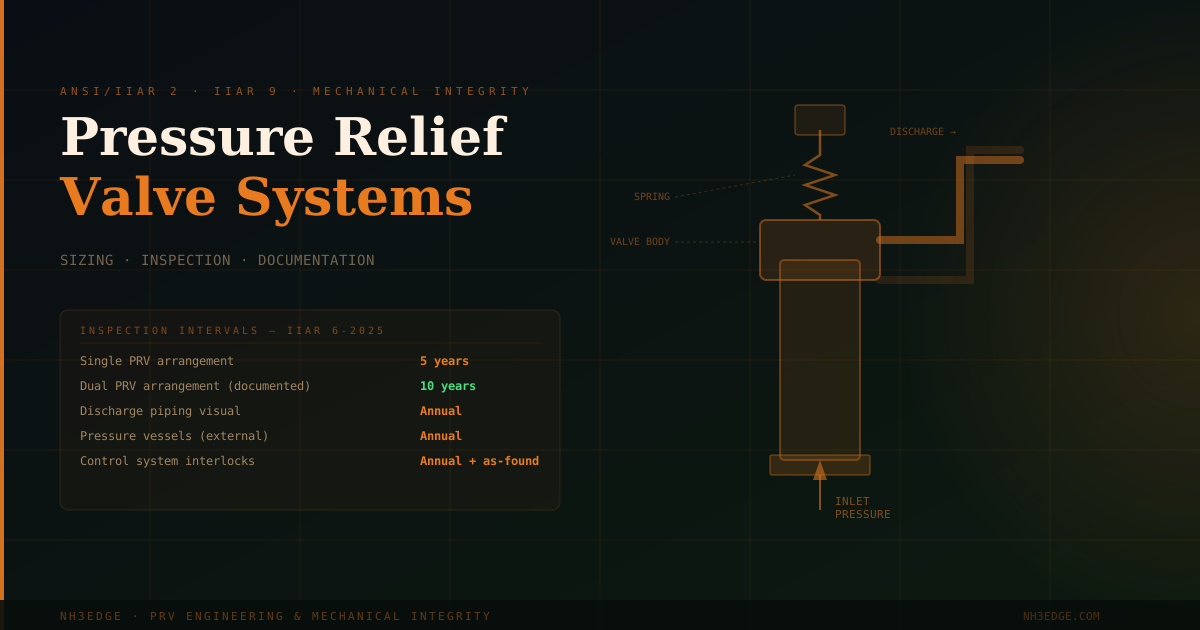
As established in IIAR 2 Section 9.9.2, pressure relief valves in ammonia service must be replaced or recertified at maximum five-year intervals. Bulletin 110 reinforces this requirement and provides guidance on PRV inspection and testing protocols.
For dual-manifold installations, the inspection program must track each individual valve with its own identification number, set pressure, and replacement/test history. A common MI program deficiency is tracking dual-manifold valves as a unit rather than individually, which creates documentation gaps when one valve is replaced without the other.
Piping Systems
Ammonia refrigeration piping presents unique challenges for an MI program. Large systems may have miles of piping in varied service conditions — hot gas, liquid high-pressure, suction, brine — each with different corrosion and degradation mechanisms.
Bulletin 110 recommends a risk-based approach to piping inspection that prioritizes:
- Injection points and deadlegs: Areas where concentration of contaminants or stagnant flow can accelerate corrosion
- Elbows and tees: Areas subject to flow-accelerated corrosion and erosion
- Insulated piping on outdoor systems: High CUI risk, particularly at penetrations and supports
- Low-point drains: Areas where water and contamination accumulate
Compressors
Reciprocating and screw compressors require a PM program that addresses both safety-related components and reliability. Bulletin 110 guidance includes:
- Vibration monitoring intervals and acceptance criteria
- Oil analysis frequency and parameters (for screw compressors)
- Shaft seal inspection intervals
- Safety control function testing — high-pressure cutout, low oil pressure cutout, high temperature cutout — at minimum annually
- Inspection of capacity control systems
Ammonia Detection Systems
Ammonia detection is covered equipment under PSM Element 8 for ammonia refrigeration facilities. Bulletin 110 and IIAR 2 establish requirements for:
- Sensor calibration: At intervals per manufacturer recommendation, typically annually at minimum. Calibration must be performed using certified standard gas of known concentration.
- Alarm setpoint verification: Confirming that alarm and shutdown setpoints are set correctly and activate appropriate outputs.
- System function testing: Confirming that detector activation propagates correctly through the control system — activating alarms, ventilation systems, and any automatic shutdowns.
Building a Deficiency Tracking System
One of the most frequently inadequate aspects of MI programs at ammonia facilities is deficiency tracking. The regulation at 1910.119(j)(5) requires that deficiencies found during inspections be corrected before further use, or that the equipment be determined safe to operate until correction. This means every deficiency must be:
A spreadsheet that lists deficiencies is not sufficient if it doesn't also capture the safety evaluation and the verified closure. OSHA inspectors specifically look for evidence that the facility had a mechanism to know whether deficiencies were addressed — not just discovered.
An effective deficiency tracking system links each deficiency to:
- The equipment item and inspection event that generated it
- An initial severity assessment (immediate safety concern vs. monitor vs. plan for next outage)
- A target resolution date
- A work order or corrective action record number
- Closure verification (who confirmed resolution and when)
Quality Assurance for Maintenance Work
OSHA 1910.119(j)(6) requires quality assurance procedures that ensure materials and spare parts are appropriate for the application, and that equipment maintenance is performed in accordance with approved procedures. For ammonia refrigeration systems, this translates to:
- Materials traceability: Any replacement component — gaskets, seals, valves, pipe fittings — must be verified as suitable for ammonia service at the operating pressure and temperature. This sounds obvious but is regularly violated: using lubricants, gasket materials, or valve trim not rated for ammonia service is a recurring finding.
- Maintenance procedure documentation: Major maintenance tasks — compressor overhauls, relief valve replacement, major piping repairs — should have written procedures that the technician follows and signs off on.
- Post-maintenance verification: After significant maintenance, a documented check confirms the equipment was returned to service correctly before restart.
Contractor Qualifications
Many ammonia facilities use contractors for specialized maintenance — pressure vessel inspection, relief valve testing and recertification, compressor overhauls. OSHA 1910.119(h) requires that contractors performing work on or near covered processes be trained on the applicable hazards and procedures.
The MI program should document how contractor qualifications are verified. For pressure vessel inspection, this typically means verifying that the inspector holds current NBIC (National Board Inspection Code) Inspector certification. For relief valve testing, verifying the recertifying shop is an ASME-authorized RV repair organization. These verifications should be documented and retained.
Getting Started: Program Gap Assessment
For facilities that don't currently have a Bulletin 110-compliant MI program, the gap assessment is the essential first step. A structured assessment identifies:
- Which equipment categories are currently covered and which are missing
- Where inspection frequencies don't meet Bulletin 110 recommendations
- Where inspection records exist but don't meet documentation standards
- Where the deficiency tracking system has gaps
- Where QA procedures are missing
Questions about building or improving a mechanical integrity program for your ammonia system? Contact NH3Edge for a consultation.
What Happens During an OSHA PSM Audit? How to Prepare Your Ammonia Facility
OSHA PSM inspections at ammonia refrigeration facilities follow a predictable pattern — inspectors know exactly what they're looking for and where programs break down. Understanding that pattern is the foundation of effective preparation.
PSM ComplianceProcess Hazard Analysis for Ammonia Systems: HAZOP vs. What-If Methodology
The PHA is the intellectual core of your PSM program — the systematic effort to identify what could go wrong before it does. Choosing between HAZOP and What-If methodology, scoping the analysis correctly, and documenting findings to OSHA's expectations are all decisions that determine whether the PHA delivers real safety value.
Industry StandardsPressure Relief Valve Sizing for Ammonia Systems: IIAR 2 and IIAR 9 Requirements
Proper PRV sizing is one of the most consequential engineering decisions in an ammonia refrigeration system — and one of the most commonly deficient during compliance audits. Here's how IIAR 2 and IIAR 9 define the methodology and what auditors actually check.
Operating an ammonia refrigeration facility?
NH3Edge provides OSHA PSM and EPA RMP compliance consulting for ammonia refrigeration facilities — third-party compliance audits, ammonia inventory determination, and continuous real-time inventory monitoring. Based in Salt Lake City, serving facilities nationwide.