
Static vs. Dynamic Ammonia Inventory: Why Your Paper Number Might Be Wrong
Picture your ammonia refrigeration system at midnight on a January night. The condensers are running efficiently at 100 psig head pressure. Your high-pressure receiver is sitting at 45% level. The low-pressure receiver is at 60%. Total calculated inventory: 8,960 pounds. You're comfortably below the 10,000-pound PSM threshold.
Now picture the same system at 2:00 PM on an August afternoon. Ambient temperature is 97°F. The condensers are working hard to maintain 185 psig head pressure. The high-pressure receiver has climbed to 72% level because liquid is condensing faster than it's evaporating. The low-pressure receiver has dropped to 38% because the evaporators are loaded up and circulating refrigerant more aggressively. Total actual inventory: the same 8,960 pounds of ammonia — but the distribution has shifted dramatically, and under certain conditions, the calculation could tell a very different story.
This is the reality of ammonia refrigeration: inventory isn't a number, it's a state.
Why Charge Migrates
To understand dynamic ammonia inventory, you need to understand basic refrigeration thermodynamics. In an ammonia refrigeration system, refrigerant exists simultaneously in multiple phases — liquid and vapor — distributed across multiple vessels and interconnecting piping. The distribution at any moment is determined by operating conditions.
Condensing pressure and temperature The condenser converts high-pressure ammonia vapor into high-pressure liquid. As ambient temperature rises, the condensing temperature must rise with it to maintain the temperature differential needed for heat transfer. Higher condensing temperature means higher condensing pressure. Higher condensing pressure means higher liquid density in the high-side vessels. More liquid accumulates on the high side.
On a hot summer day, significantly more ammonia is sitting in liquid form in your high-pressure receiver than on a cool winter night. This isn't a leak or a system change — it's basic thermodynamics responding to ambient conditions.
Evaporator load and suction pressure On the low side, the evaporators absorb heat from the refrigerated space and convert liquid ammonia into vapor. Higher refrigeration loads mean higher evaporation rates, which means more refrigerant is circulating actively through the evaporators. The flooded evaporators maintain a relatively constant liquid level, but the quantity of refrigerant in transit — in the suction risers, accumulators, and liquid supply lines — can shift noticeably.
Condenser flooding Some systems use liquid refrigerant in the condenser header or shell to control head pressure on cold nights. As ambient temperature drops and fewer condenser fans are needed, refrigerant floods into the condenser. This liquid in the condenser is part of your inventory — but it's in a location that isn't always measured or accounted for in static calculations.
Purger operation Automatic purgers remove non-condensable gases (air, nitrogen) from the system by venting them from high points where non-condensables accumulate. Every purger cycle removes a small quantity of ammonia along with the non-condensables. Over time, these losses compound. If your system purges aggressively, your actual inventory may be meaningfully lower than your initial calculation — or you may have added makeup ammonia that isn't reflected in old documentation.
The Snapshot Problem
A static ammonia inventory calculation is a snapshot. It captures your inventory at a specific moment under specific conditions. The calculation is only valid for that moment.
Consider what it means to perform a static inventory assessment:
This is competent work, done correctly. But three months later, in the middle of summer:
- Condensing pressure has risen by 80 psi
- High-pressure receiver liquid level has risen by 15%
- The liquid density in the high-side vessels has changed
- Actual system inventory may be materially different
How Much Does Inventory Shift?
The magnitude of inventory migration depends on your system's size, configuration, and operating range. In a 9,000-pound system with a broad operating range (say, -40°F to +95°F ambient), total inventory migration between extreme conditions can range from 200 to 800 pounds or more in larger systems.
For a facility sitting at 9,200 pounds on paper, that migration range matters enormously. If your system shifts 600 pounds of refrigerant distribution between winter and summer operating conditions, you may be crossing 9,800 pounds regularly — a few hundred pounds from triggering PSM/RMP requirements you thought didn't apply.
To quantify the migration for your specific system:
Across a full system with multiple vessels, this math adds up quickly.
The Consequence of Not Knowing
Regulatory compliance is the obvious consequence of inventory uncertainty. But it's not the only one.
Emergency response: If there's an ammonia release, first responders need to know how much refrigerant is in the system. A stale inventory number could mean emergency planners are preparing for a 9,000-pound release when the actual release potential is 11,000 pounds.
Threshold management: Some facilities intentionally manage their inventory to stay below the PSM threshold — either by limiting system size or by intentionally keeping less refrigerant in the system. Without real-time inventory data, they're flying blind on their most important operational constraint.
System optimization: Refrigerant migration patterns reveal operating inefficiencies. If your high-pressure receiver is frequently overcrowded, you may be operating with too much refrigerant in the system, reducing efficiency and potentially causing high-head-pressure issues.
Makeup charge decisions: When do you add refrigerant? When do you remove it? Without knowing your actual inventory at any moment, these decisions are guesswork.
The Solution: Continuous Measurement
The technology to solve this problem has existed in industrial control systems for decades. Level transmitters, pressure transducers, and temperature sensors connected to a PLC have been standard equipment in ammonia refrigeration plants for years. The gap was the calculation layer and the monitoring context that translates those sensor readings into a live inventory number.
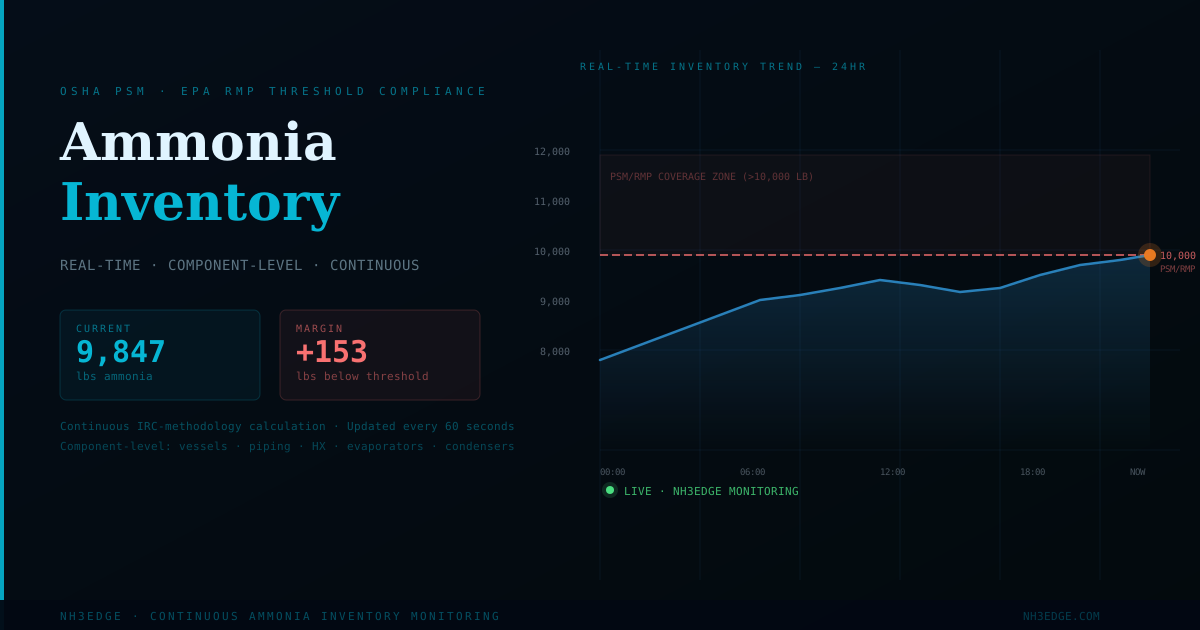
NH3Edge fills that gap. By reading level, pressure, and temperature data from existing PLCs and sensors in real time, and running the same thermodynamic calculations that a static assessment uses — but running them continuously, every few seconds — NH3Edge converts raw sensor data into a live ammonia mass inventory.
The calculation runs exactly as the component-level methodology describes:
- Vessel level → liquid volume (using stored vessel geometry)
- Operating pressure → saturation temperature (from ammonia property tables)
- Saturation temperature → liquid density (from thermodynamic data)
- Liquid volume × liquid density → liquid mass
- Vapor volume × vapor density → vapor mass
- Sum across all vessels → total system inventory
That's the difference between a paper number and an operational reality. NH3Edge gives you the operational reality.
Want to see how continuous inventory monitoring would work on your system? Contact us for a consultation.
Understanding the 10,000-Pound Threshold: When PSM and RMP Apply to Your Ammonia System
The 10,000-pound ammonia threshold triggers two of the most consequential regulatory programs in industrial safety. Here's what it means, how it's determined, and why so many facilities don't know where they actually stand.
PSM ComplianceProcess Hazard Analysis for Ammonia Systems: HAZOP vs. What-If Methodology
The PHA is the intellectual core of your PSM program — the systematic effort to identify what could go wrong before it does. Choosing between HAZOP and What-If methodology, scoping the analysis correctly, and documenting findings to OSHA's expectations are all decisions that determine whether the PHA delivers real safety value.
Monitoring TechnologyAmmonia Charge Calculation Methods: Component-Level Methodology Explained
Knowing exactly how much ammonia is in your system — at any given moment, in any given vessel — is both a regulatory requirement and a practical safety tool. A component-level thermodynamic calculation provides the engineering framework. Continuous monitoring automates what used to be a periodic manual calculation.
Operating an ammonia refrigeration facility?
NH3Edge provides OSHA PSM and EPA RMP compliance consulting for ammonia refrigeration facilities — third-party compliance audits, ammonia inventory determination, and continuous real-time inventory monitoring. Based in Salt Lake City, serving facilities nationwide.