
Understanding the 10,000-Pound Threshold: When PSM and RMP Apply to Your Ammonia System
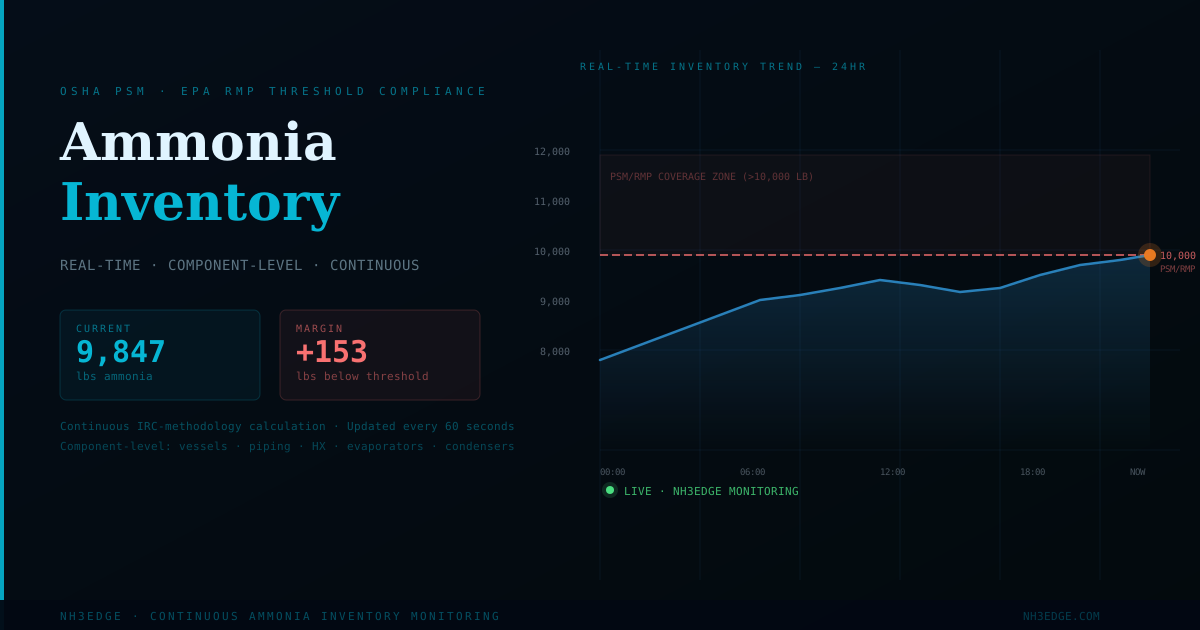
If you operate an ammonia refrigeration system, the number 10,000 should be tattooed on the back of your eyelids. That's the threshold — in pounds of anhydrous ammonia — above which your facility becomes subject to OSHA's Process Safety Management standard (29 CFR 1910.119) and EPA's Risk Management Program (40 CFR Part 68). Cross it, and you're not just buying extra paperwork. You're entering a compliance universe that includes mandatory Process Hazard Analysis, a 14-element safety program, EPA reporting, potential third-party audits, and exposure to six-figure OSHA penalty proposals.
The frustrating part? Hundreds of facilities across the United States are subject to these regulations and don't know it.
What the Regulations Actually Say
OSHA PSM (29 CFR 1910.119) applies to processes that involve a "highly hazardous chemical" above its threshold quantity. Ammonia (anhydrous) is listed in Appendix A with a threshold quantity of 10,000 pounds. Once your process contains 10,000 pounds or more of ammonia at any point, you are covered.
EPA RMP (40 CFR Part 68) applies to stationary sources that have more than a threshold quantity of a regulated substance in a process. Ammonia (anhydrous) is a Program 3 substance under RMP with the same threshold: 10,000 pounds. If you're over the threshold, you're required to submit a Risk Management Plan to the EPA and comply with Program 3 requirements, which include a prevention program that substantially mirrors OSHA PSM.
Both regulations use the same threshold quantity. Both regulations define "process" broadly to include any combination of equipment and vessels that handles the regulated substance. Both regulations trigger at the point of inventory — not at the point of a release.
The Nameplate Problem
Here's where facilities consistently get into trouble: they calculate their ammonia inventory based on equipment nameplates or system specifications, not on actual operating conditions.
Consider a high-pressure receiver with a nameplate refrigerant charge of 2,400 pounds. That number appears on the vessel datasheet. It gets entered into a spreadsheet. It gets submitted to a regulator. But what does the nameplate number actually represent?
In most cases, it represents the maximum design charge — the amount of ammonia the vessel could hold if it were entirely full of liquid at design conditions. During normal operation, that vessel might be running at 60% liquid level at 95°F condensing temperature. The actual ammonia mass in the vessel at that moment is a function of:
The nameplate number doesn't tell you any of that. It's a design parameter, not an operating measurement.
Across a full system — multiple vessels, miles of piping, many evaporators and condensers — these discrepancies compound. A facility that is confident their system contains 8,800 pounds based on nameplate data may actually be operating with 9,600 pounds under summer operating conditions. They cross the 10,000-pound threshold during a heat wave and have no idea.
How Inventory Is Properly Determined
The International Institute of Ammonia Refrigeration (IIAR) publishes charge management guidance that provides a methodology for calculating ammonia refrigerant charge at the component level. Component-level calculation from actual operating conditions is the recognized and generally accepted good engineering practice (RAGAGEP) for ammonia inventory determination.
A proper inventory calculation accounts for:
Pressure vessels (receivers, intercoolers, surge drums):
- Actual vessel geometry (inside diameter, length, head type)
- Operating liquid level (percentage)
- Saturation properties at operating pressure (liquid density, vapor density)
- Both liquid mass and vapor mass
- Coil or plate volume
- Typical liquid fill fraction during operation
- Operating temperature/pressure and corresponding fluid properties
- Pipe diameter, wall thickness, and length for each line segment
- Identification of liquid lines (full of liquid) vs. vapor/two-phase lines
- Operating conditions for each segment
- Vessel volume
- Operating level
- Dilution factor for oil/ammonia mixture
Static vs. Actual: The Gap Nobody Talks About
Even a properly executed component-level calculation is a snapshot in time. It reflects your ammonia inventory at the conditions that existed when the calculation was performed. Operating conditions change continuously:
- Ambient temperature: Higher ambient temperatures push more ammonia to the liquid side of the system as condensing pressure rises and more refrigerant is needed in the high side. Systems that are comfortably below 10,000 lb in January may cross the threshold in July.
- Production load: Higher refrigeration loads increase the evaporator charge as more refrigerant is circulated. Lower loads shift refrigerant back to high-side receivers.
- Condenser cycling: When condenser fans cycle off on cool nights, condensing pressure drops, refrigerant migrates from the high side, and inventory distribution shifts.
- Equipment additions: Adding an evaporator or extending piping increases total system charge. Many facilities make system changes without recalculating their inventory.
Common Misconceptions
"We're under 10,000 lb because our system was designed for that." System design charge and operating charge are not the same. Design charge is a specification; operating charge is a thermodynamic reality. They diverge based on conditions.
"We calculated our inventory once. We know where we are." When was the calculation done? What were the operating conditions? Has anything changed since? A three-year-old calculation tells you where you were, not where you are.
"We asked our refrigeration contractor and they said we're fine." Unless your contractor performed a formal component-level calculation with every vessel, heat exchanger, and pipe run accounted for, that's an opinion, not a determination.
"The EPA and OSHA only care about the number we submit." OSHA inspectors are required to verify inventory determinations during PSM inspections. An unsupported or incorrect inventory calculation is itself a PSM violation.
What to Do if You're Near the Threshold
If your facility's ammonia inventory is within 2,000 pounds of the 10,000-pound threshold — either above or below — you need a formal, documented, component-level inventory determination. This isn't optional; it's the foundation of your regulatory compliance position.
If you're already over the threshold and haven't implemented a PSM program, you have a more urgent problem. OSHA PSM violations carry penalties up to $15,625 per day per violation, and willful violations are substantially higher. The time to address this is before an OSHA inspection, not during one.
If you're approaching the threshold and want to understand your position in real time — not just on paper — that's where continuous monitoring becomes not just useful, but operationally critical.
The 10,000-pound threshold isn't a target to stay under by luck. It's a regulatory line that requires precision, documentation, and ongoing awareness. NH3Edge provides all three.
Questions about your facility's inventory or compliance status? Schedule a consultation with the NH3Edge team.
Ammonia Charge Calculation Methods: Component-Level Methodology Explained
Knowing exactly how much ammonia is in your system — at any given moment, in any given vessel — is both a regulatory requirement and a practical safety tool. A component-level thermodynamic calculation provides the engineering framework. Continuous monitoring automates what used to be a periodic manual calculation.
Monitoring TechnologyStatic vs. Dynamic Ammonia Inventory: Why Your Paper Number Might Be Wrong
Most facilities calculate their ammonia inventory once and file the number. But refrigerant charge is not static — it migrates continuously between vessels as operating conditions change. Here's what that means for your compliance position.
PSM ComplianceProcess Hazard Analysis for Ammonia Systems: HAZOP vs. What-If Methodology
The PHA is the intellectual core of your PSM program — the systematic effort to identify what could go wrong before it does. Choosing between HAZOP and What-If methodology, scoping the analysis correctly, and documenting findings to OSHA's expectations are all decisions that determine whether the PHA delivers real safety value.
Operating an ammonia refrigeration facility?
NH3Edge provides OSHA PSM and EPA RMP compliance consulting for ammonia refrigeration facilities — third-party compliance audits, ammonia inventory determination, and continuous real-time inventory monitoring. Based in Salt Lake City, serving facilities nationwide.