
Real-Time Ammonia Monitoring: How Edge Computing Changes Compliance
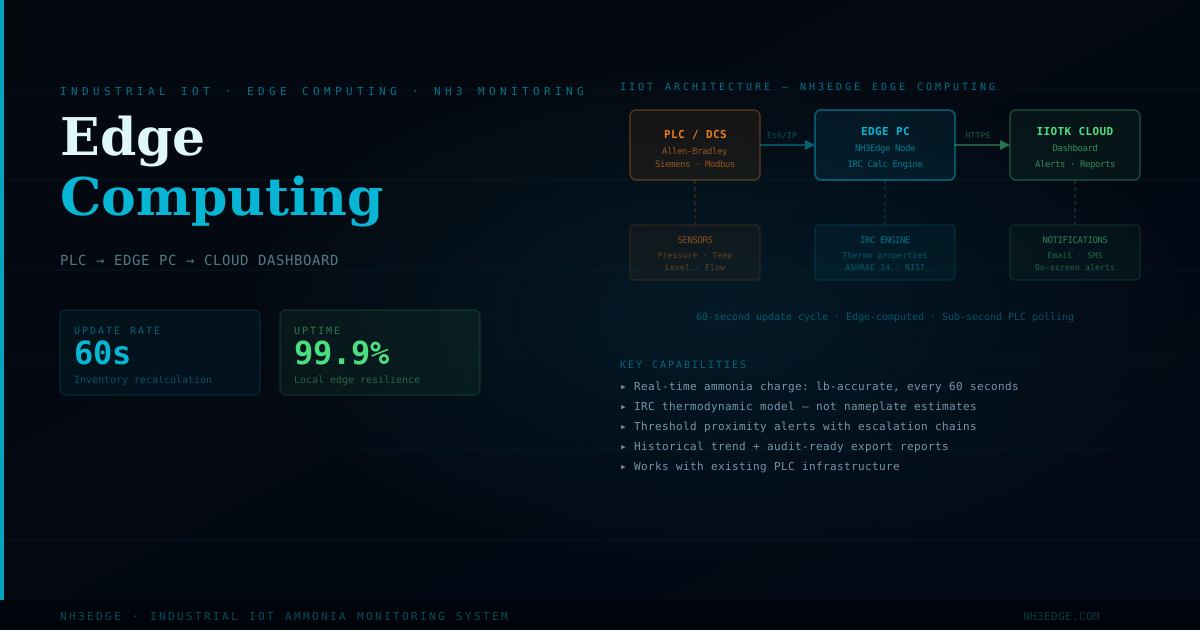
Ammonia refrigeration is one of the most heavily monitored industrial processes in the country — and also one of the most inconsistently monitored. Facilities that should have real-time visibility into system pressures, temperatures, levels, and ammonia concentration often rely on operator walkdowns, periodic data logs from their PLC, or dashboard displays that nobody checks systematically. The compliance consequences of this monitoring gap are significant, and the technical gap between "we have sensors" and "we have actionable, continuous monitoring" is larger than most operators realize.
Edge computing is the architecture that closes this gap for ammonia refrigeration facilities. Understanding what it is, why it matters for safety-critical industrial applications, and how it differs from both traditional SCADA and cloud-only IoT solutions is the starting point for understanding what modern ammonia monitoring should look like.
The Monitoring Problem at Industrial Refrigeration Facilities
Most ammonia refrigeration facilities were designed and built with control systems that were appropriate for their era — PLCs that control the refrigeration process reliably, local HMI panels that display system status, and alarm systems that alert operators to out-of-limit conditions in the machinery room. This is adequate for operational control of the refrigeration process.
What it doesn't provide is:
- Centralized, searchable historical data that compliance and safety personnel can query to verify system behavior over time
- Automated calculation of derived values — component-level ammonia inventory, approach temperature tracking, system efficiency metrics
- Remote visibility that allows facilities management or corporate safety personnel to see system status without being physically present
- Automated compliance documentation — records of operating parameters, alarm events, and detector readings that PSM documentation requires
The Cloud-Only Alternative and Its Limitations
The IoT revolution of the past decade created a wave of cloud-first monitoring solutions that promised to solve the SCADA affordability problem. The architecture is appealing in concept: sensors report data to the internet, data is stored and processed in a cloud platform, and users access dashboards through a web browser. No on-site servers, no Windows licensing, no IT infrastructure.
For many industrial monitoring applications — energy monitoring, building management, fleet tracking — cloud-first IoT works well. For safety-critical industrial monitoring at ammonia refrigeration facilities, it has a fundamental reliability problem:
The monitoring is only as reliable as the internet connection.
Ammonia refrigeration systems don't stop operating when the internet goes down. A refrigerant leak doesn't pause for a fiber outage or a failed LTE modem. If the cloud-only monitoring system loses connectivity at the moment an ammonia detector activates, the cloud dashboard shows nothing — and any automated alerts based on that data are never sent. For a system that OSHA and EPA expect to be continuously monitored, "it was offline when the event happened" is not an acceptable answer.
Beyond reliability, cloud-only architectures introduce latency that can matter in fast-developing scenarios. Data that must travel from a sensor, through a local network, over an internet connection, to a cloud server, through a processing pipeline, and back to an alert recipient before any action is triggered may experience delays of seconds to minutes. For monitoring applications where early warning is the value proposition, this latency undermines the benefit.
There's also the cybersecurity question. Connecting industrial control system sensors — or worse, PLCs with control authority — directly to cloud platforms without an intermediate security layer creates attack surfaces that industrial security frameworks like IEC 62443 specifically warn against.
What Edge Computing Solves
Edge computing places computational intelligence at the "edge" of the network — physically close to the data sources, inside the facility — rather than either on a central on-site server or in a remote cloud. In an industrial monitoring context, an edge computer is a ruggedized, purpose-built computing device installed in the facility that:
- Collects data locally from PLCs, sensors, and instrumentation via industrial protocols
- Processes and analyzes data locally — running calculations, applying alarm logic, generating derived values — without dependency on internet connectivity
- Stores data locally as a buffer, ensuring no data loss during connectivity interruptions
- Synchronizes with the cloud when connectivity is available, uploading historical data and receiving configuration updates
This architecture is particularly well-suited to ammonia refrigeration because it provides the continuous, reliable monitoring that safety regulations imply — and the cloud connectivity that enables remote access, corporate reporting, and data analytics — without the vulnerabilities of either pure SCADA or cloud-only approaches.
How NH3Edge Implements Edge Computing
The NH3Edge platform is built around this edge-first architecture. At each facility, an industrial-grade edge computer is installed in the machinery room or control panel. This device serves as the local hub for all refrigeration monitoring.
PLC Integration
NH3Edge connects to the facility's existing PLC via standard industrial communication protocols — primarily EtherNet/IP (the protocol used by Allen-Bradley/Rockwell PLCs, which dominate industrial refrigeration in North America) and Modbus TCP/RTU (a universal protocol supported by virtually all industrial PLCs and many standalone instruments). This means NH3Edge reads data directly from the control system that already runs the refrigeration process — the same pressures, temperatures, levels, and status signals the operators see on their HMI.
No rewiring of sensors is required for most installations. The edge computer connects to the PLC's existing data table via Ethernet and reads the values. This read-only connection means NH3Edge has no ability to command the control system — a critical safety boundary.
For facilities with older PLCs that don't support Ethernet communication, NH3Edge can integrate analog signals (4-20mA) directly through field wiring to a local I/O module that the edge computer reads. This pathway supports older control systems that would otherwise be incompatible with network-based monitoring.
Data Processing at the Edge
Once data is collected, the edge computer runs the NH3Edge monitoring engine locally. This engine executes:
- Component-level ammonia inventory calculations — using the thermodynamic methodology described in our charge calculation post, updated every scan cycle from live process data
- Approach temperature calculations — tracking condenser and evaporator approach temperatures as efficiency indicators
- Alarm logic — applying configurable alarm setpoints to all monitored points with alarm delay, hysteresis, and priority logic
- Trend analysis — detecting rate-of-change conditions that indicate developing problems before thresholds are exceeded
IIOTK Cloud Synchronization
The NH3Edge edge computer continuously synchronizes with the IIOTK Cloud platform. IIOTK (Industrial Internet of Things Knowledge) provides the cloud-side infrastructure for:
- Long-term data storage and retrieval — years of historical data accessible through the NH3Edge web dashboard
- Remote monitoring dashboards — accessible from any web browser, providing corporate safety personnel, compliance consultants, and remote management with the same visibility as on-site operators
- Automated compliance reports — scheduled reports that document operating parameters, alarm events, and inventory calculations in formats useful for PSM documentation
- Multi-facility visibility — organizations with multiple ammonia facilities can view all facilities from a single dashboard, with normalized data that enables cross-facility comparison
Cybersecurity Architecture Advantages
The edge architecture provides inherent cybersecurity advantages over direct cloud connectivity. The edge computer sits between the OT (operational technology) network — the PLCs and control systems — and the IT/internet network. Data flows outbound from OT to edge to cloud; there is no inbound pathway from the internet to the control system.
This separation aligns with the ISA/IEC 62443 standard for industrial cybersecurity, which requires security level zones and conduits between networks of different security levels. A cloud-only system that connects directly to the PLC network for data collection doesn't naturally achieve this separation; an edge-first architecture makes it the default.
The Practical Case for Edge-First Monitoring
The regulatory expectations for ammonia refrigeration monitoring are clear: continuous detection, documented records, and rapid alert capability. OSHA PSM requirements for mechanical integrity, emergency response, and incident investigation all benefit from — and in some interpretations require — the kind of documented, timestamped operational history that continuous monitoring provides.
Traditional SCADA can deliver this, but at a cost and complexity that many facilities cannot sustain. Cloud-only IoT cannot reliably deliver it because the monitoring is only as dependable as the internet connection. Edge computing provides the local reliability of SCADA with the accessibility and analytics capability of cloud platforms — at a fraction of the cost and complexity of a full SCADA deployment.
For ammonia refrigeration facilities that need to demonstrate continuous, documented, reliable monitoring to OSHA, EPA, and their own management, the edge computing architecture is not just a technology preference — it's the architecture that matches the reliability requirements of safety-critical industrial monitoring.
Questions about edge computing and real-time monitoring for your ammonia facility? Contact NH3Edge for a consultation.
AI in the Ammonia Refrigeration Control System: Four Places It Earns Its Keep
AI in an ammonia machinery room is not about letting software run the plant. It's about finally being able to ask the historian a question in plain English, ask the PLC program what an interlock actually does, understand how the system behaves as a whole, and pull compliance evidence from the data that was already there. Here's where it delivers, and where the guardrails have to be.
Monitoring TechnologyAmmonia Charge Calculation Methods: Component-Level Methodology Explained
Knowing exactly how much ammonia is in your system — at any given moment, in any given vessel — is both a regulatory requirement and a practical safety tool. A component-level thermodynamic calculation provides the engineering framework. Continuous monitoring automates what used to be a periodic manual calculation.
Monitoring TechnologyStatic vs. Dynamic Ammonia Inventory: Why Your Paper Number Might Be Wrong
Most facilities calculate their ammonia inventory once and file the number. But refrigerant charge is not static — it migrates continuously between vessels as operating conditions change. Here's what that means for your compliance position.
Operating an ammonia refrigeration facility?
NH3Edge provides OSHA PSM and EPA RMP compliance consulting for ammonia refrigeration facilities — third-party compliance audits, ammonia inventory determination, and continuous real-time inventory monitoring. Based in Salt Lake City, serving facilities nationwide.