
The 14 Elements of OSHA PSM: A Practical Guide for Ammonia Refrigeration Facilities
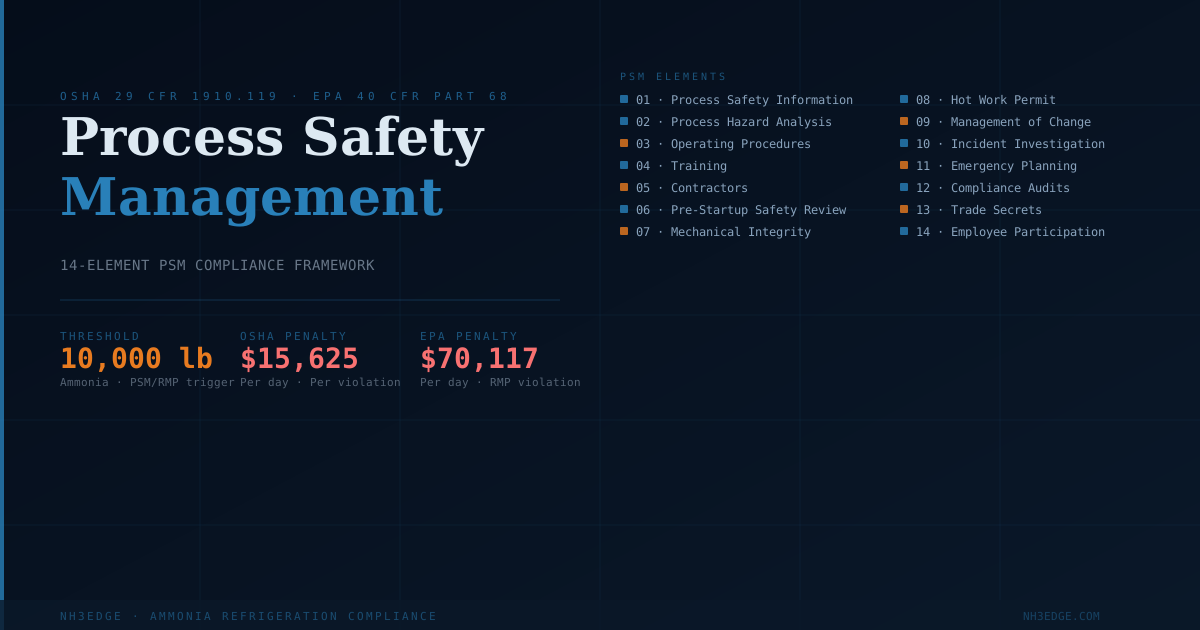
OSHA's Process Safety Management standard, found at 29 CFR 1910.119, establishes 14 elements that covered facilities must implement. Each element has specific requirements, specific documentation expectations, and specific audit targets. For ammonia refrigeration facilities, the elements aren't abstract — they map directly to things your facility does (or doesn't do) every day.
This guide walks through each element with specific application to ammonia refrigeration. It's written from the perspective of someone who has audited dozens of ammonia facilities against these requirements and seen the same deficiencies appear repeatedly.
Element 1: Employee Participation (1910.119(c))
What it requires: A written plan for employee participation in the development and implementation of all PSM elements. Employees must have access to all PSM information and be consulted in PHAs.
What OSHA looks for:
- A written employee participation plan (not just a policy statement)
- Evidence that operators were involved in PHA sessions
- Documentation that employees can access PSM records
- Training records showing employees understand their role in PSM
Element 2: Process Safety Information (PSI) (1910.119(d))
What it requires: Compilation and maintenance of written process safety information before any PHA is conducted. PSI must include: hazard information about the chemical, process technology information, and process equipment information.
For ammonia:
- Safety Data Sheet (SDS) for anhydrous ammonia
- Hazardous properties: flammability limits (15-28% in air), IDLH (300 ppm), TLV-TWA (25 ppm), vapor pressure, density data
- Block flow diagrams and P&IDs (current, accurate, approved)
- Process chemistry and design intent
- Safe upper and lower limits for process parameters (temperature, pressure, level)
- Evaluation of consequences of deviating from safe limits
- Codes and standards used in design (ASME, IIAR 2, etc.)
- Materials of construction
- Relief device settings and design basis (this links directly to PRV analysis)
- Ventilation system design
- Safety system design and function
- Electrical classification
- Design documentation for each pressure vessel, relief device, and major piece of equipment
Element 3: Process Hazard Analysis (PHA) (1910.119(e))
What it requires: A formal, systematic hazard analysis of each covered process, using one of the following methodologies: What-If, Checklist, What-If/Checklist, HAZOP, FMEA, Fault Tree Analysis, or equivalent. PHAs must be revalidated every 5 years.
For ammonia refrigeration: The HAZOP methodology is most appropriate for large, complex ammonia systems because it systematically examines each section of the process (nodes) for deviations from design intent. Simpler systems may use a structured What-If approach effectively.
The PHA team must include:
- Personnel with engineering and process knowledge
- Personnel with operating experience (operators — not just managers)
- A person knowledgeable in the PHA methodology
- Hazards of the process
- Identification of prior incidents (including near-misses)
- Engineering and administrative controls
- Consequences of failure of controls
- Facility siting
- Human factors
- A qualitative evaluation of effects of failure of controls
Unresolved PHA recommendations are a serious finding. OSHA treats an open PHA recommendation as evidence that a known hazard has not been controlled.
Element 4: Operating Procedures (1910.119(f))
What it requires: Written operating procedures for each covered task that cover: initial startup, normal operations, temporary operations, emergency shutdown (including who authorizes it), emergency operations, normal shutdown, and startup following turnarounds or emergency shutdowns.
For ammonia refrigeration:
- Startup procedures (seasonal startup, post-maintenance startup)
- Normal operations (rounds, monitoring, adjustments)
- Temporary operations (bypassed equipment, degraded modes)
- Emergency shutdown triggers and sequence
- Partial system shutdown (individual circuit or condenser shutoff)
- Full system shutdown
- Post-maintenance startup checklist
Critical requirement: Procedures must be reviewed annually and certified as accurate by the employer. They must be in the language of the operators who use them and must reflect current practice — not how the system was supposed to work when it was originally built.
Common deficiency: Operating procedures that were written once and never updated when the system changed. If your system went through a significant modification and the operating procedures still describe the old configuration, this is a finding.
Element 5: Training (1910.119(g))
What it requires: Initial training for each employee in an operating position, and refresher training every 3 years (or more frequently if needed). Training must cover operating procedures and PSM requirements.
Documentation: Training records must be maintained showing the date, the subjects covered, the trainer's name, and the employee's acknowledgment. Oral tests are not sufficient documentation. Written tests or practical demonstrations with records are required.
Refresher timing: The 3-year clock is per employee. If an operator was hired in 2021 and trained then, their refresher is due by 2024. OSHA inspectors will ask for training records for every operator in an operating position and check the dates.
Element 6: Contractors (1910.119(h))
What it requires: A contractor safety program that covers the safety performance of contractors working on or near a covered process. Employers must inform contractors of known hazards, explain emergency procedures, control contractor access, and evaluate contractor safety performance periodically.
For ammonia facilities: Any contractor who performs maintenance, modification, or other work that could affect the ammonia system must be informed of the ammonia hazards and emergency evacuation procedures before starting work. This means every refrigeration technician, pipefitter, and electrician working in your engine room.
Contractors must also be informed of emergency response procedures and the location and function of emergency equipment. A pre-job safety briefing — documented — is the minimum.
Evaluation requirement: The employer must evaluate the safety performance of contractors periodically. This means actually tracking contractor incidents and near-misses and documenting your evaluation.
Element 7: Pre-Startup Safety Review (PSSR) (1910.119(i))
What it requires: A safety review before startup of a new facility or modified facility when the modification triggers the Management of Change (MOC) procedure. The PSSR must verify that: construction and equipment meet design specs, PSI is in place, procedures are in place, any changes that required MOC have been addressed, and training has been completed.
For ammonia refrigeration: Any significant system modification — adding a new vessel, modifying piping, adding instrumentation — that goes through the MOC process triggers a PSSR before startup. The PSSR is typically a checklist-based review with documented sign-off.
Common deficiency: Skipping the PSSR when a modification is completed because "we're in a hurry to get it running." No PSSR documentation = PSM violation.
Element 8: Mechanical Integrity (1910.119(j))
What it requires: A written MI program covering: pressure vessels and storage tanks, piping systems, relief and vent systems, emergency shutdown systems, controls, and pumps. The MI program must include: inspection procedures, inspection frequency, documentation, equipment deficiency correction, and quality assurance for all maintenance work.
For ammonia refrigeration: This is the most substantive PSM element for a typical ammonia facility. IIAR Bulletin 110 provides the RAGAGEP for inspection frequencies and maintenance requirements. The MI program must specify, for each piece of covered equipment:
- Who inspects it
- How it's inspected (procedure)
- How frequently (interval)
- What qualifications the inspector needs
- How deficiencies are documented and tracked
- When deficiencies must be corrected
- What quality assurance applies to maintenance work
Element 9: Hot Work Permits (1910.119(k))
What it requires: A hot work permit system for hot work (cutting, welding, grinding, heating) conducted on or near a covered process.
For ammonia facilities: Hot work in or near an engine room requires a permit that verifies: the area is free of flammable or toxic materials; fire prevention measures are in place; equipment is properly isolated; fire watch is established; and relevant personnel have been notified.
This is relatively straightforward to implement but frequently underimplemented. Informal verbal approvals don't satisfy the permit requirement.
Element 10: Management of Change (MOC) (1910.119(l))
What it requires: A written MOC procedure for all changes to process chemicals, technology, equipment, procedures, or facilities that are not "replacement in kind." Before any such change is made: the technical basis for the change must be documented; the impact on safety and health must be analyzed; any required operating procedure modifications must be identified; employees must be notified and trained; and the PSI must be updated.
What constitutes a change vs. replacement in kind: Replacing an ammonia level transmitter with the exact same model is replacement in kind — no MOC required. Changing to a different manufacturer or model, or changing the setpoint, is a change that requires MOC.
For ammonia refrigeration: Common MOC triggers:
- Adding a new evaporator or circuit
- Changing PRV set pressures
- Modifying control logic or setpoints
- Changing piping configuration
- Adding or removing instrumentation
- Changing refrigerant operating levels
- Modifying the ammonia charge (adding or removing refrigerant)
Element 11: Incident Investigation (1910.119(m))
What it requires: Investigation of every incident (or near-miss) that resulted in, or could have resulted in, a catastrophic release. Investigation must begin within 48 hours. The report must include: date, description, contributing factors, recommendations. Recommendations must be resolved within the same timeframe as PHA recommendations.
For ammonia facilities: Near-miss incidents — a small release that was quickly contained, an instrument failure that could have caused an overpressure, a valve that leaked — must be investigated with the same rigor as actual release incidents.
Culture note: Many ammonia facilities don't have a near-miss reporting culture. Incidents are often categorized as "routine maintenance issues" rather than PSM incidents. OSHA's view is that if the incident could have reasonably resulted in a catastrophic release, it required investigation.
Element 12: Emergency Planning and Response (1910.119(n))
What it requires: Integration with the OSHA Emergency Action Plan (29 CFR 1910.38) and, for facilities subject to EPA RMP, an Emergency Response Program. The emergency response plan must cover procedures for handling small releases, include provisions for medical treatment of employees injured by the chemical, and address employee evacuation.
For ammonia facilities: Many facilities in food processing and cold storage rely on the local LEPC (Local Emergency Planning Committee) and fire department for emergency response. This is acceptable under PSM if: you have a written coordination agreement with the local fire department; you maintain the notification procedures; and local responders have current information about your facility's ammonia inventory and system layout.
Facilities that have their own emergency response capability must meet more stringent requirements.
Element 13: Compliance Audits (1910.119(o))
What it requires: A compliance audit of the PSM program every 3 years, conducted by at least one person knowledgeable in the process. The audit must evaluate whether the PSM program and procedures are adequate and are being followed. Deficiencies identified must be corrected.
Practical note: The 3-year audit is often the only time a facility systematically reviews whether their PSM program is actually being implemented as written. Many facilities have excellent documentation but poor implementation. The audit should identify both.
Audit team: The regulation says "at least one person knowledgeable in the process." OSHA prefers that the auditor have some independence from the day-to-day operation. Internal audits are acceptable, but an external audit by someone with ammonia refrigeration and PSM expertise provides more defensible documentation and more objective findings.
Element 14: Trade Secrets (1910.119(p))
What it requires: A written trade secret policy explaining how employees and contract employees can access PSM information even if that information is claimed as a trade secret. Employees may not be denied access to PSI needed for safe operation on the basis of trade secrecy.
For ammonia facilities: This is typically the simplest element to implement. Ammonia refrigeration systems don't typically involve patented processes or proprietary chemical formulations. A brief written policy stating that no PSM information is withheld on trade secret grounds, and that all employees have access to all PSM information, satisfies the requirement.
The Integration Requirement
These 14 elements are not independent. They form an integrated system:
- PSI (Element 2) provides the technical foundation for the PHA (Element 3)
- The PHA identifies hazards that inform operating procedures (Element 4) and training (Element 5)
- The MI program (Element 8) inspects the equipment documented in PSI
- The MOC procedure (Element 10) ensures that changes trigger updates to PSI, procedures, and PHA as needed
- Incident investigations (Element 11) feed back into the PHA and procedure improvements
Need help evaluating your current PSM program against all 14 elements? Contact NH3Edge for a compliance audit.
AI in the Ammonia Refrigeration Control System: Four Places It Earns Its Keep
AI in an ammonia machinery room is not about letting software run the plant. It's about finally being able to ask the historian a question in plain English, ask the PLC program what an interlock actually does, understand how the system behaves as a whole, and pull compliance evidence from the data that was already there. Here's where it delivers, and where the guardrails have to be.
PSM ComplianceProcess Hazard Analysis for Ammonia Systems: HAZOP vs. What-If Methodology
The PHA is the intellectual core of your PSM program — the systematic effort to identify what could go wrong before it does. Choosing between HAZOP and What-If methodology, scoping the analysis correctly, and documenting findings to OSHA's expectations are all decisions that determine whether the PHA delivers real safety value.
Industry StandardsBuilding a Mechanical Integrity Program for Ammonia Refrigeration: IIAR Bulletin 110 in Practice
OSHA PSM Element 8 requires a documented mechanical integrity program — and for ammonia refrigeration systems, IIAR Bulletin 110 defines what 'good' looks like. Here's how to build a program that satisfies the standard and actually protects equipment.
Operating an ammonia refrigeration facility?
NH3Edge provides OSHA PSM and EPA RMP compliance consulting for ammonia refrigeration facilities — third-party compliance audits, ammonia inventory determination, and continuous real-time inventory monitoring. Based in Salt Lake City, serving facilities nationwide.