
Pressure Relief Valve Sizing for Ammonia Systems: IIAR 2 and IIAR 9 Requirements
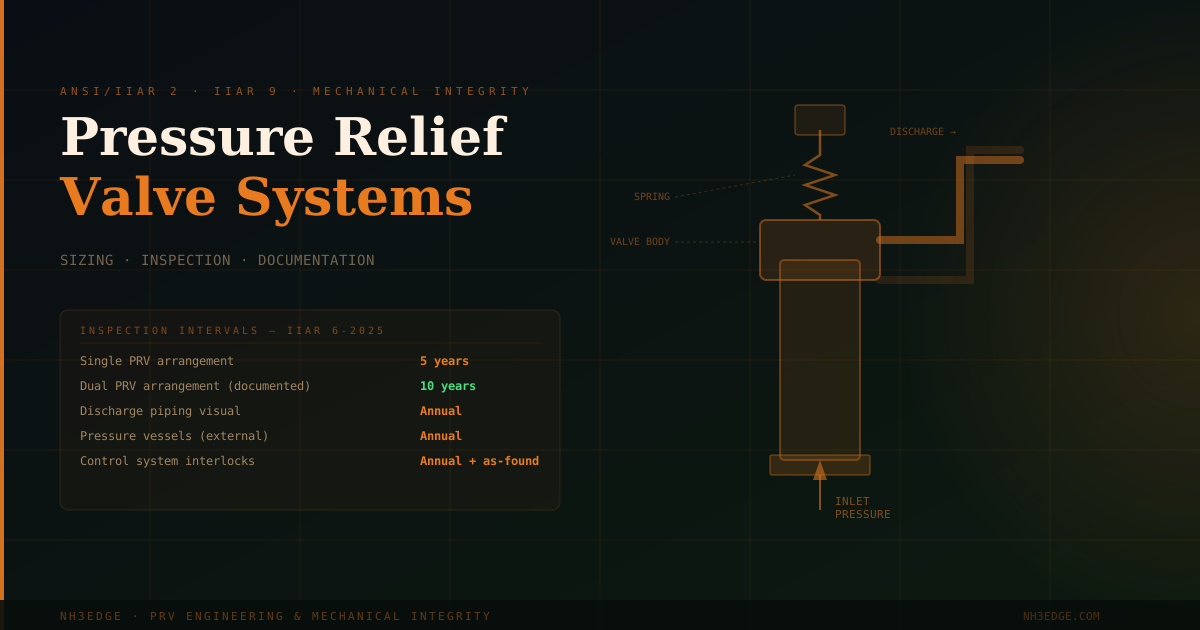
Pressure relief valves are the last line of defense against catastrophic overpressure in an ammonia refrigeration system. When every other layer of protection fails — when a control valve sticks open, when a vessel is exposed to fire, when discharge is inadvertently blocked — the PRV is what stands between a process excursion and a catastrophic release. Getting the sizing right isn't optional, and the regulatory and industry standard framework that governs it is more nuanced than many operators realize.
This post walks through the IIAR 2 and IIAR 9 requirements for PRV sizing, the specific scenarios you must evaluate, how to verify your existing relief valves are adequate, and the most common deficiencies I encounter during PSM audits.
The Regulatory Framework: Where PRV Requirements Come From
For facilities subject to OSHA PSM (29 CFR 1910.119), pressure relief devices are addressed under Element 8 — Mechanical Integrity — and Element 2 — Process Safety Information. The PSI requirement at 1910.119(d)(3)(i)(C) specifically requires documentation of the design codes and standards employed, and PRV sizing calculations are part of that package.
The Recognized and Generally Accepted Good Engineering Practice (RAGAGEP) for ammonia refrigeration PRVs is established primarily by two IIAR standards:
- IIAR 2 (Equipment, Design, and Installation of Closed-Circuit Ammonia Mechanical Refrigeration Systems): Establishes the requirement that every pressure vessel and certain other components be protected by a pressure relief device, and specifies the design pressure requirements that sizing must account for.
- IIAR 9 (Minimum System Safety Requirements for Existing Closed-Circuit Ammonia Refrigeration Systems): Applies specifically to existing systems and establishes equivalent requirements for evaluating whether installed PRVs are adequate.
Overpressure Scenarios You Must Evaluate
The core of PRV sizing is identifying the credible overpressure scenarios for each vessel or protected system segment. IIAR 2 requires that PRVs be sized for the worst-case credible scenario. For ammonia refrigeration systems, the primary scenarios are:
Fire Exposure
Fire exposure is frequently the governing case for high-side vessels, particularly where the machinery room or outdoor equipment is located in areas with combustible material nearby. The ASME/API 521 methodology calculates the required relief rate based on the wetted surface area of the vessel, a fire heat input factor, and the latent heat of vaporization of ammonia at the relieving pressure.
The ASME formula for fire exposure relief load (in pounds per hour) is:
W = FA / (λ)
Where:
- F = environmental factor (1.0 for bare vessel, reduced for insulated vessels per API 521 Table 5)
- A = total wetted surface area (ft²)
- λ = latent heat of vaporization of ammonia at relieving pressure (BTU/lb)
Blocked Discharge
This scenario occurs when the outlet of a heat exchanger or vessel is blocked while heat continues to be added. For high-pressure receivers and condensers, blocked discharge from a non-condensable gas purge line or a failed outlet valve can generate significant relief loads. Sizing must account for the maximum heat input rate at the blocked condition.
Loss of Cooling
For vessels that contain ammonia at conditions where ambient heat gain could cause pressure buildup — particularly low-pressure receivers during a compressor shutdown or power failure — the relief valve must be sized to handle the heat leak rate from the environment into the vessel contents. This scenario is often overlooked for low-side equipment.
Thermal Relief
Liquid-full piping segments and heat exchangers require thermal relief for the thermal expansion of trapped liquid ammonia. While the required capacity for thermal relief is typically small, the scenario must be identified and addressed. IIAR 2 Section 9.10 addresses relief device requirements for liquid-filled components.
Abnormal Heat Input
In refrigeration systems, abnormal heat input scenarios include hot gas defrost at unintended high pressure, or the introduction of high-pressure refrigerant into a low-pressure vessel through a failed valve. These system-specific scenarios require evaluation during the PHA and must be reflected in PRV sizing documentation.
The Sizing Calculation: What It Actually Involves
A proper PRV sizing calculation for an ammonia vessel is not a lookup table — it's a documented engineering calculation that includes:
Back pressure deserves special attention in ammonia systems. Many facilities route PRV discharge to a common header or treatment system, and the built-up back pressure can significantly derate a conventional (non-balanced) relief valve. IIAR 2 requires that PRVs be sized accounting for actual back pressure conditions. Where back pressure exceeds approximately 10% of set pressure for a conventional valve, a balanced bellows or pilot-operated relief valve should be used.
Dual Relief Valve Manifolds
IIAR 2 Section 9.9 requires that pressure vessels operating continuously be equipped with a manifold arrangement that allows one PRV to remain in service while the other is removed for inspection and testing. This three-way valve arrangement must be configured so that at least one relief path is always open — it is not permissible to close both valves simultaneously, even during maintenance.
The dual valve manifold requirement is frequently misunderstood. I've audited facilities where both valves on a dual manifold were the same size as a single-valve installation would require — which is correct. I've also found facilities where operators assumed the two valves together needed to handle the full relief load, and each valve was undersized as a result. The IIAR 2 requirement is that each individual valve on a dual manifold must be capable of handling the full required relief load independently.
Common Deficiencies Found During Audits
After reviewing PRV systems at dozens of ammonia facilities, certain deficiencies appear with frustrating regularity:
- No sizing calculations on file. The most common deficiency. Valves were installed based on contractor selection or original design assumptions that no longer reflect the current system configuration. OSHA PSI requirements demand that these calculations exist and be current.
- Calculations don't match installed valves. The installed valve is a different orifice designation than what the calculation specifies, often because a valve was replaced with a "like-for-like" without verifying the replacement met the original sizing basis.
- Fire case not evaluated. Particularly common for indoor high-side equipment where fire exposure was deemed unlikely but not formally documented.
- Back pressure not accounted for. Common-header discharge systems where the back pressure assumption in the original calculation was zero, but actual system back pressure under relief conditions is significant.
- Dual manifold valves undersized. As described above — each valve must independently handle the full relieving load.
- PRVs overdue for replacement. IIAR 2 Section 9.9.2 requires that PRVs on systems containing ammonia be replaced or recertified on a maximum five-year interval. Many facilities lose track of this requirement.
- Set pressure exceeds MAWP. Vessels that have been modified or repressurized without updating the relief valve set pressure documentation.
Verifying Your Existing PRVs Are Adequate
If you don't have sizing calculations on file — which, frankly, describes a majority of older facilities — here's how to approach verification:
This is exactly the type of gap analysis that regulators expect to see under PSM Mechanical Integrity programs. Having it documented demonstrates that your facility has applied engineering rigor to its protection systems — even if deficiencies are found in the process.
IIAR 9 Considerations for Existing Systems
IIAR 9, which addresses existing ammonia refrigeration systems, establishes that PRVs must meet the requirements of the edition of IIAR 2 that was in effect at the time of installation, or must be upgraded to meet current IIAR 2 requirements. This creates a practical challenge: older systems installed under earlier editions of IIAR 2 may have PRVs that were compliant when installed but do not meet current sizing methodology.
IIAR 9 Section 9.9 establishes specific relief device requirements for existing systems and defines the inspection and replacement intervals. The standard also requires that any modifications to the system — adding vessels, changing operating pressures, modifying process flows — trigger a re-evaluation of PRV sizing for affected components.
Questions about PRV sizing or pressure relief compliance at your ammonia facility? Contact NH3Edge for a consultation.
Building a Mechanical Integrity Program for Ammonia Refrigeration: IIAR Bulletin 110 in Practice
OSHA PSM Element 8 requires a documented mechanical integrity program — and for ammonia refrigeration systems, IIAR Bulletin 110 defines what 'good' looks like. Here's how to build a program that satisfies the standard and actually protects equipment.
PSM ComplianceWhat Happens During an OSHA PSM Audit? How to Prepare Your Ammonia Facility
OSHA PSM inspections at ammonia refrigeration facilities follow a predictable pattern — inspectors know exactly what they're looking for and where programs break down. Understanding that pattern is the foundation of effective preparation.
PSM ComplianceProcess Hazard Analysis for Ammonia Systems: HAZOP vs. What-If Methodology
The PHA is the intellectual core of your PSM program — the systematic effort to identify what could go wrong before it does. Choosing between HAZOP and What-If methodology, scoping the analysis correctly, and documenting findings to OSHA's expectations are all decisions that determine whether the PHA delivers real safety value.
Operating an ammonia refrigeration facility?
NH3Edge provides OSHA PSM and EPA RMP compliance consulting for ammonia refrigeration facilities — third-party compliance audits, ammonia inventory determination, and continuous real-time inventory monitoring. Based in Salt Lake City, serving facilities nationwide.