
What Happens During an OSHA PSM Audit? How to Prepare Your Ammonia Facility
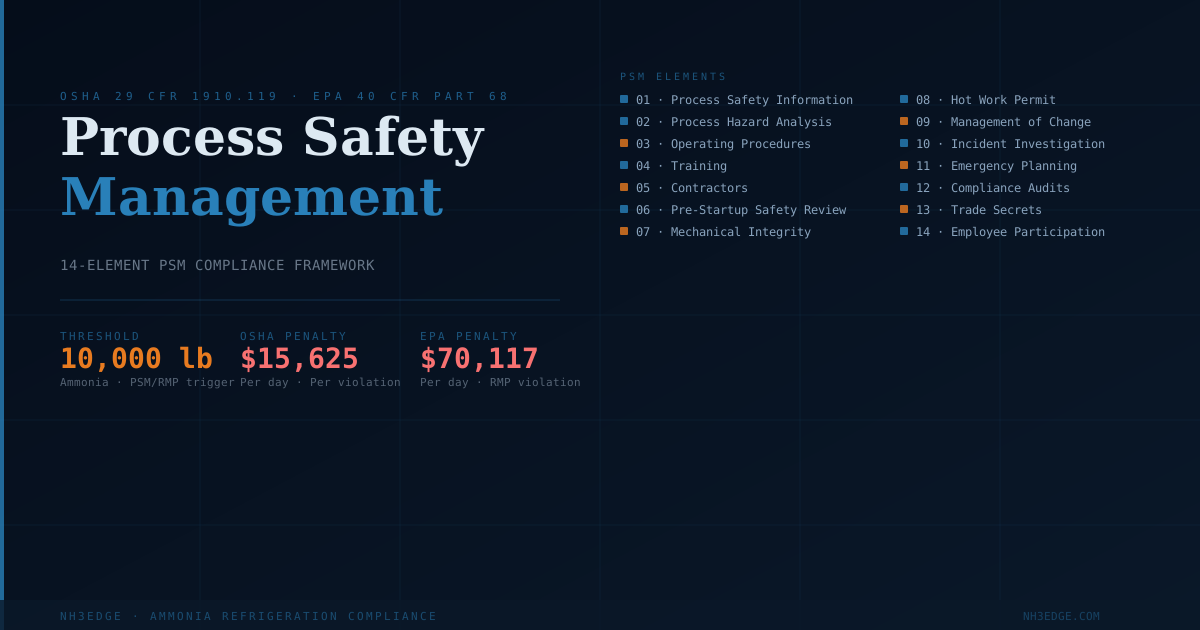
An OSHA PSM inspection is not a random event. Inspectors at ammonia refrigeration facilities work from established inspection procedures, focus on a predictable set of documentation requests, and consistently find the same categories of deficiencies across the industry. That predictability is actually an advantage for prepared facilities — it means the inspection is winnable, not a matter of luck.
This post walks through what actually happens during a PSM inspection at an ammonia refrigeration facility, what documentation OSHA inspectors will request, the most commonly cited violations, and concrete strategies for self-auditing before the inspector arrives.
How OSHA PSM Inspections Are Triggered
Before discussing preparation, it's worth understanding how inspections happen. OSHA conducts PSM inspections through several mechanisms:
- Programmed inspections: OSHA's National Emphasis Program (NEP) for PSM-covered facilities (updated under CPL 03-00-021) targets facilities with covered processes for scheduled inspections. Ammonia refrigeration facilities above the 10,000-pound threshold are explicitly within scope.
- Incident-driven inspections: Any ammonia release that results in injury, hospitalization, or community response is likely to trigger an OSHA investigation. These inspections tend to be more intensive and may expand from the incident into a full PSM compliance audit.
- Referral inspections: OSHA receives referrals from EPA following RMP incident reports, from state agencies, and from employee complaints. A complaint from a current or former employee about inadequate safety practices is a common trigger.
- Follow-up inspections: Facilities cited in prior inspections may receive follow-up visits to verify abatement of cited items.
What Happens on Day One
When OSHA arrives, the opening conference establishes the scope of the inspection and begins the document collection process. Inspectors typically request an initial document package that includes:
- The PSM written program
- Current P&IDs (marked with revision status)
- The most recent Process Hazard Analysis and any revalidations
- The written operating procedures for the ammonia system
- The Mechanical Integrity inspection program and recent inspection records
- The Management of Change procedure and MOC records for the past three years
- The Pre-Startup Safety Review procedure and recent PSSR records
- Employee training records
- The Emergency Action Plan and Emergency Response Plan
- Incident investigation records for the past five years
- The employee participation plan
Employee interviews are a critical and often underestimated component. OSHA inspectors will ask to speak with operators, maintenance technicians, and supervisors — privately and without management present. The questions focus on whether employees actually follow written procedures, whether they understand the hazards of ammonia, and whether they've been trained on emergency response.
The Top Five PSM Citation Categories at Ammonia Facilities
Across OSHA's published inspection data and citation records, five categories of violations dominate at ammonia refrigeration facilities:
1. Process Safety Information — P&IDs Not Current (1910.119(d))
This is the most frequently cited violation at ammonia facilities, and for good reason — P&IDs are notoriously difficult to keep current at facilities that make incremental changes over years of operation. Inspectors compare field conditions against the current P&ID revision and document every discrepancy: added valves, relocated sensors, removed equipment, changed piping runs.
The standard at 1910.119(d)(3) is clear: process safety information must be complete and accurate. "We know it's not perfect" is not a defense. The regulatory expectation is a documented process for keeping P&IDs current — including MOC review of every field change — and evidence that process is actually followed.
What OSHA specifically checks: They look at the P&ID revision date relative to the date of the last system modification. They walk the system with a P&ID in hand. A common finding is that a new vessel or heat exchanger was added years ago without any P&ID revision or MOC record.
2. Mechanical Integrity — No Inspection Program (1910.119(j))
OSHA expects a written mechanical integrity program that identifies covered equipment, establishes inspection frequency, documents inspection criteria, and tracks deficiencies to resolution. Many facilities have some inspection activities but lack the systematic, documented program the standard requires.
Common specific deficiencies include: pressure vessels with no documented inspection history, pressure relief valves that haven't been replaced or tested within the required interval, ammonia detectors with no calibration records, and safety shutdowns with no function-test documentation.
3. Process Hazard Analysis — Revalidation Overdue (1910.119(e))
Under 1910.119(e)(6), PHAs must be updated and revalidated at intervals not to exceed five years. This is a hard deadline — there is no provision for extension. Facilities that allowed their PHA revalidation to lapse by even one day are in violation.
Beyond the timing issue, OSHA inspectors evaluate the quality of PHA documentation. A revalidation that simply rubber-stamps the previous study without genuinely revisiting the process as it currently exists — accounting for system modifications, near-miss incidents, and changes in personnel — will draw scrutiny.
4. Operating Procedures — Not Accurate or Not Available (1910.119(f))
Written operating procedures must cover normal operations, temporary operations, startup, shutdown, emergency operations, and startup after emergency shutdown. They must reflect the process as it currently operates and must be accessible to operators in the work area.
Common deficiencies: procedures that reference equipment no longer in service, startup sequences that don't match current system configuration, no emergency shutdown procedure for loss-of-containment scenarios, and procedures locked in a manager's office rather than available in the machinery room.
5. Management of Change — No Records of Changes (1910.119(l))
The MOC requirement applies to any change to the process chemistry, technology, equipment, procedures, or facilities — except for "replacement in kind." OSHA's interpretation of what constitutes a change versus replacement in kind is broad: changing a valve to a different model number, rerouting piping, adding instrumentation all typically require MOC.
The most damaging finding in an MOC audit is discovering a significant system modification — a new high-pressure receiver, a compressor replacement, a machinery room expansion — with no MOC record, no updated P&ID, no PSSR documentation, and no PHA review of the change. This chain of interconnected violations compounds rapidly.
How to Self-Audit Before OSHA Arrives
A structured self-audit using OSHA's own inspection procedures is the most effective preparation strategy. Here's how to approach it:
Step 1: Document Inventory and Currency Check
Compile every PSM document and check revision dates against system modification history. For each MOC record, verify the associated P&ID was updated, the PSSR was completed, and operating procedures were revised if affected.
Step 2: P&ID Field Verification
Walk your entire ammonia system — every vessel, every significant valve, every instrument — with a current P&ID in hand. Mark every discrepancy. This is uncomfortable work because it surfaces problems, but it's far better to discover them yourself.
Step 3: Mechanical Integrity Program Gap Analysis
For every category of covered equipment (pressure vessels, piping, relief devices, emergency shutdown systems, controls, pumps, compressors), verify:
- An inspection procedure exists
- The frequency is compliant with applicable RAGAGEP (IIAR Bulletin 110, NBIC, ASME)
- Inspection records exist for the past three years
- Deficiencies identified in inspections were tracked to resolution
Step 4: Training Records Audit
Pull training records for every operator and maintenance technician. Verify initial training and annual refresher training against the written training program requirements. Gaps in training records — even for long-tenured employees — are citable.
Step 5: PHA and Revalidation Review
Confirm the date of your most recent PHA or revalidation. If you're within 12 months of the five-year anniversary, start planning the revalidation now. Review PHA findings from the current cycle and verify that all recommendations were resolved and documented.
Step 6: Conduct a Mock Interview
Sit down with operators and maintenance technicians and ask the questions OSHA will ask: What do you do if you detect an ammonia release? Where is the emergency action plan? How do you start up the system after an emergency shutdown? Can you show me where the operating procedures are? The answers reveal gaps that document review doesn't.
Documentation to Have Ready
When OSHA arrives, you want to be able to produce the following within minutes rather than hours:
- PSM program document (the overarching written program)
- Current P&IDs with revision history
- Complete PHA and all revalidations
- MOC log for the past five years
- PSSR records for the past five years
- MI inspection records organized by equipment
- PRV replacement/test records
- Detector calibration records
- Safety shutdown function test records
- Training records by employee
- Incident investigation reports
- Emergency response plan
- Contractor safety records
One Final Point
OSHA inspections at ammonia facilities are ultimately about whether your facility would actually protect workers and the community in a real emergency. The documentation is evidence of that. When I work with facilities on PSM compliance, I always frame it this way: if your P&IDs are accurate, your people are trained, your equipment is inspected, and your procedures reflect reality, you don't just pass an OSHA audit — you run a safer facility. The compliance posture and the safety outcome are the same thing.
Questions about preparing your ammonia facility for an OSHA PSM audit? Contact NH3Edge for a consultation.
Building a Mechanical Integrity Program for Ammonia Refrigeration: IIAR Bulletin 110 in Practice
OSHA PSM Element 8 requires a documented mechanical integrity program — and for ammonia refrigeration systems, IIAR Bulletin 110 defines what 'good' looks like. Here's how to build a program that satisfies the standard and actually protects equipment.
PSM ComplianceProcess Hazard Analysis for Ammonia Systems: HAZOP vs. What-If Methodology
The PHA is the intellectual core of your PSM program — the systematic effort to identify what could go wrong before it does. Choosing between HAZOP and What-If methodology, scoping the analysis correctly, and documenting findings to OSHA's expectations are all decisions that determine whether the PHA delivers real safety value.
Industry StandardsPressure Relief Valve Sizing for Ammonia Systems: IIAR 2 and IIAR 9 Requirements
Proper PRV sizing is one of the most consequential engineering decisions in an ammonia refrigeration system — and one of the most commonly deficient during compliance audits. Here's how IIAR 2 and IIAR 9 define the methodology and what auditors actually check.
Operating an ammonia refrigeration facility?
NH3Edge provides OSHA PSM and EPA RMP compliance consulting for ammonia refrigeration facilities — third-party compliance audits, ammonia inventory determination, and continuous real-time inventory monitoring. Based in Salt Lake City, serving facilities nationwide.